







The Galien Foundation
medal
Join us

    The Galien Foundation
      Prix Galien Medal
      Join us
      Prix Galien Coin
      Join us
      Speaker-2
      GALIEN BRIDGES FORUM 2026

      More / Better Life?

      Wisdom Beyond the Hype

      Tuesday December 1st
      Nobel Forum | Karolinska Institutet
      10:00 AM - 6:00 PM
      Stockholm, Sweden

      The 2026 Bridges Forum asks how a region with some of the world’s oldest populations, richest health registries, and strongest prevention cultures should approach longevity. The day moves from what the science can credibly deliver, with healthspan as a critical measure, to who should govern and benefit from the region’s health data, and whether drugs and brain training together can do what neither does alone, then closing on key strategic choices: whether to lead the longevity race or redefine it, and where to invest.

      Bridges Forum Co-Chairs


      Mikael Dolsten
      Prix Galien Bridges Committee Chair


      Carl Johan Sundberg
      Prix Galien Bridges Committee members; Professor & Vice President, Karolinska Institutet Nord


      10:30 - 10:40 I Welcome Remarks
      Martin Bergö
      Professor & Vice President, Karolinska Institutet

      Thomas Perlmann
      Professor, Karolinska Institutet; Secretary-General, Nobel Assembly
      Nobel Forum
      10:40 - 11:25 | Session 1

      Longevity: Separating progress from promise

      Moderator
      Mikael Dolsten
      Longevity1

      Humanity extended life spectacularly, from Semmelweis to plummeting infant mortality to the post-50 health revolution, without ever calling it "longevity science." The label arrived later, and with it a blurring of terms: average lifespan, maximum lifespan, and healthspan (the years lived in good health) are not the same thing, and only one of them is what most people actually want more of. Nor are the gains we take for granted secure: AMR threatens a post-antibiotic era, climate change is driving organ damage and infectious diseases toward the poles, and the interventions with the strongest evidence (food, movement, social connection) are the ones the longevity industry talks about least. Nordics+, with the world’s oldest populations, richest health registries, and strongest prevention cultures, sits at the center of this tension, and the choices it makes on data infrastructure, market access, manufacturing, and ethical boundaries will determine whether the region leads or merely ages. This session establishes the day's scientific and human framework.

      Moderator

      Mikael Dolsten
      Chair, Prix Galien Bridges Committee & Forum Co-Chair

      Alon Chen
      Bridges Committee members; President, Weizmann Institute of Science

      Sara Hägg
      HeaAssociate Professor in Molecular Epidemiology, Karolinska Institutet; PI, Swedish Adoption/Twin Study of Aging 

      Peter Stenvinkel
      Professor of Nephrology, Karolinska Institutet; Senior Physician, Karolinska University Hospital

      11:40 - 12:35 | Session 2

      The Nordics+ data edge: Discovery, access, and control

      Moderator
      Sabine Koch
      data_Edge

      Assessing whether longevity interventions actually work requires tracking populations for decades, and measuring healthspan, not just survival. The Nordics+ should be the global leader here: interconnected registries, digitally native populations and universal healthcare together form one of the world's richest engines for medical discovery. Yet the advantage is underused. Each country builds its own platforms and guards its own data, cross-border research remains rare, and when it is attempted the registries often fail to line up. Industry reports that access delays are its primary competitive challenge, and that it avoids cross-border studies as a result. Underneath sits a harder question about control: who may reach this data, who captures the value of what runs through it, and who can keep it safe. Can the Nordics+ make its data interoperable enough to generate transformative research, workable enough to reward the companies that use it, and resilient enough to protect what has become a strategic asset? 

      Moderator

      Sabine Koch
      Head of Learning, Informatics, Management and Ethics (LIME), Karolinska Institutet

      Johanna Lidén
      Senior Director, Sweden & Nordic Medical & Regulatory Affairs, AstraZeneca  

      Lili Milani
      Head, Estonian Biobank, University of Tartu

      Aarno Palotie
      Bridges Committee members; Research Director, Human Genomics, Institute for Molecular Medicine Finland (FIMM), HiLife

      Michel Silvestri
      Senior Adviser, Swedish eHealth Agency/E-hälsomyndigheten

      13:30 - 14:25 | Session 3

      Hybrid therapies: Can drugs and brain training together do what neither does alone?

      Moderator
      Miia Kivipelto
      Hybrid_Therapies

      Do the most powerful interventions live at the intersection of molecules and discipline? Could structured cognitive or sensory training amplify a drug's effect, or pairing pharmacology with brain exercise slow decline in ways neither achieves alone? The science is promising but unproven, and this is where the region holds a distinctive advantage: Israel's pioneering work in brain, cognition, and technology offers the neuroscience, while the Nordics+ tradition of treating movement and lifestyle as medicine offers the means to test whether synergy is real or wishful thinking. How would a single-payer system reimburse a therapy that is part pill, part protocol? Can Nordics+ and its partners pioneer the disciplined study of combination approaches that industry alone cannot validate?

      Moderator

      Miia Kivipelto
      Professor in Clinical Geriatrics, Karolinska Institutet Center for Alzheimer Research; Senior Geriatrician & Director for R&D of Theme Aging, Karolinska University Hospital

      Amir Amedi
      Co-Founder & Chief Scientific Officer, Remepy; Professor, Schools of Medicine & Psychology, Reichman University; Founding Director, Baruch Ivcher Institute for Brain, Cognition & Technology and Ruth and Meir Rosental Brain Imaging Center

      Christian Howell
      CEO, Cognito

      Emre Ozcan
      Global Head of Integrated Health & Medicines, Merck Healthcare KGaA

      Mikael Svensson
      Professor of Applied Health Economics, University of Gothenburg, Sweden; Head, Public Health Section, Institute of Medicine

      14:40 - 15:40 | Session 4

      The Lagom conundrum: Should Nordics+ lead the longevity race, or redefine it around healthspan?

      Moderator
      Carl Johan Sundberg
      Lagom

      The longevity industry promises more life at any cost. The Nordic tradition whispers lagom (enough is enough) and asks whether the measure that matters is healthspan rather than years alone. But which instinct should guide a region that has both the scientific firepower to push boundaries and the egalitarian values to ask whether it should? Novo Nordisk is Danish, yet GLP-1 access varies across the Nordics+. The welfare model promised universal, equal care: what happens when 30% of the population is over 65 and the most promising interventions are priced for the few? Should Nordics+ pursue longevity science aggressively and sort out access later, or is restraint itself a form of leadership? Can wisdom and ambition coexist, or does a region that optimizes for healthspan forfeit the frontier? 

      Moderator

      Carl Johan Sundberg
      Bridges Committee members; Professor & Vice President, Karolinska Institutet Nord; Bridges Forum Co-Chair

      Erik Renström
      Bridges Committee members; Vice-Chancellor, Lund University

      Ingrid Miljeteig
      Professor of Medical Ethics, University of Bergen 

      Magnus Thyberg
      Director General, TLV (Dental and Pharmaceutical Benefits Agency)

      16:00 - 17:20 | Session 5

      Build, license, or cede? The economics of longevity innovation 

      Moderator
      Erika Söderberg Johnsson

      The next generation of longevity technologies is arriving now. The Nordics+ has the scientific firepower to lead, but the binding constraint is capital. Often, breakthroughs discovered in Nordic labs scale in Boston, because the risk capital, late-stage financing, and appetite for long bets live elsewhere. The region faces a choice: build the platform and risk being undercapitalized, or license it away and capture only a fraction of the value. Value licensed abroad is value not reinvested in the region's own health system, and its patients end up waiting for therapies developed elsewhere and priced for other markets, in a region where the over-65 population has grown by nearly a third in 25 years while the working-age population has shrunk, and where the supply chain beneath even the medicines it does make runs through a handful of countries far away. Which platforms are ready to build on, and which are still more promise than proof? Where should the region commit capital to lead rather than license? And can Nordics+ capture the value of its own science before the window closes?

      Moderator

      Erika Söderberg Johnsson
      Board member, Saab, Camurus AB & Stegra; former CFO, Novo Nordisk Foundation

      Peter Bisgaard
      Managing Partner, Pivotal Life Sciences; Chairman, QuantumCell

      Johan Christenson
      Partner, HealthCap

      Thomas Eldered
      Founder & Executive Chairman, Flerie

      Kasper Lage
      Managing Director, Novo Nordisk Foundation Center for Genomic Mechanisms of Disease, Broad Institute of MIT & Harvard

      Ylva Trolle Lagerros
      Professor in Cardiovascular Prevention, Department of Medicine, Huddinge, Karolinska Institutet; Senior Physician, Center for Obesity, Stockholm

      Veronika Sexl
      Bridges Committee members; Rector, University of Innsbruck

      17:20 - 17:50 | Nominees Presented
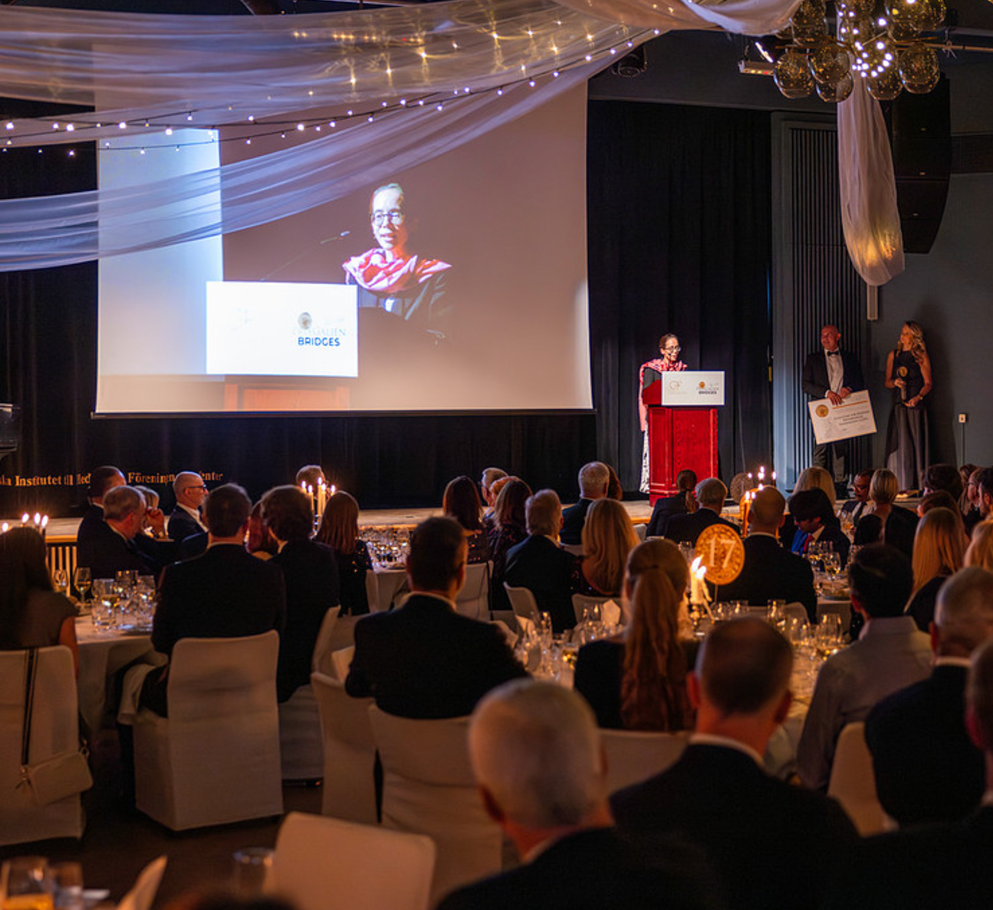
      Bridges

      Prix Galien Bridges

      Nominees will be presented in the following categories:

      • Best Bridge-Builder Institution

      • Best Biotechnology & Pharmaceutical Product

      • Best Medical Technology/AI

      • Best Product for Rare/Orphan Diseases

      • Best Public Sector Innovation

      • Best Enabling Technology